
Inspire the World, Create the Future.
For Smartphone Users.

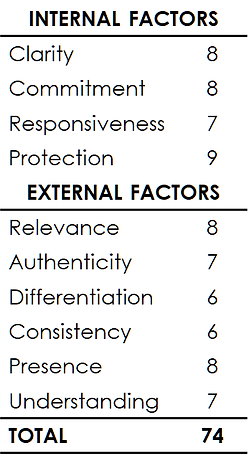
With a Brand Strength Total of 74, Samsung's brand discount rate is 7.2%, which indicates the rate of return that could be earned on an investment in the financial markets with similar risk or the opportunity cost of capital.
CLARITY (8)
Through Samsung various marketing campaigns, there is a high clarity on what the brand stands with regards to its values, positioning, and proposition. The brand actively voices out “#DoWhatYouCant” to appeal to a younger demographic, mainly Millennials and Gen Zs, and promoting that anyone can do anything.
Samsung’s marketing campaigns are mainly focused on lifestyles, such as dancers, travelers, sports, outdoor activities, cooking, and many more. The tactic here is to better relate the brand image with consumers’ everyday lives and allow them to associate the brand image with “lively” and “fun”.
Nevertheless, when there is a new product launch, Samsung also has marketing campaigns that focus on the usage of its new phones. These campaigns usually include their most popular brand ambassador, kpop band BTS, as well as local social media influencers for all the markets it has business operations in.
COMMITMENT (8)

In terms of gaming features, Samsung formed a partnership with Discord, a popular gaming chat app, to integrate the app into Samsung’s Game Launcher. This strategy was implemented to appeal to the gamer target market of Samsung and build a stronger brand resonance with them.
Samsung has formed partnerships various major players to increase support on its product development, including gaming features and software.
In terms of software upgrades, Samsung has formed a partnership with Microsoft. This allowed Microsoft to bundle its android apps on Galaxy Note 10. In addition, Microsoft also stocks Samsung’s products and sells them through its retail channels. Meanwhile, Samsung also stocks Microsoft’s products and promotes them through its channels. This is a cross-promotion tactic to support each other.

RESPONSIVENESS (7)

According to Samsung, its engineers have always been re-imagining every aspect of a mobile phone way before smartphones came into the market. Samsung has always been on the frontier to push the limits of mobile technology.
In 1999, Samsung developed a “watch phone” to enhance productivity on-the-go. This was launched before “smartwatches” were introduced in the market. In addition, Samsung is focused on improving user experience, and thus, launched the True Color Phone in 2002, which uses active matrix LCD display. This innovation led to Samsung’s current popular Galaxy series of smartphones.
With Samsung’s flagship phones on the rise and leading the industry, the brand continues to experiment with new ideas and expanding the user experience. Some of the many ideas implemented include: edge display, infinity display, large screen smartphones (Note series), S Pen, as well as a suite of functionalities.
Samsung is currently working on 5G connectivity and has more 5G patents than other companies. It is also the first to to receive FCC approval for its 5G network equipment.
PROTECTION (9)
Samsung tops the US patent list with a granted total of 9,413 utility patents, received 605 design patents, and also made 8,668 utility patent applications.
Recently, the brand won a major patent for a foldable version of their Galaxy Note series. It also won the patent for edge display.
All in all, Samsung is ranked first in the number of granted patents for 5G.

RELEVANCE (8)
The desire to be productive, active and trendy is an aim for many Millennials. Samsung is tackling this aspect through their Galaxy series. Samsung has always found ways to compare itself with Apple, who is globally known to be top-tier and high quality. The brand previously launched marketing materials that threw shade at Apple, however all these marketing materials have been taken down from the internet. While some may say that this is a bad idea since Apple is a well established company, the marketing material works for android consumers.
According to Prophet's annual brand relevance survey, Samsung is one of the best examples of creating connectivity as it has positioned itself as a continuous innovative brand.
Samsung has a localization marketing strategy for different market it has business operations in. For example, in Malaysia, it leverages on Malaysian social media influencers to promote the products. Whenever it launches a new product, the global offices start of with the large marketing campaigns distributed by headquarters. Afterwards, they employ local strategies to further push the products to the markets they are situated in. Nevertheless, all the marketing campaigns are aligned with Samsung’s style.

AUTHENTICITY (7)
Samsung is a company that comes across as fun, trendy, and hip where it constantly push out viral TikTok campaigns via the numerous K-pop celebrities amidst the latest technological innovation.
However this actually obfusticate Samsung’s wonderful core brand message: #dowhatyoucant, which has so much potential as an empowering message towards its biggest market segment, the Millenials.
Additionally, by tying the brand to K-Pop, it would come across as inauthentic, as K-Pop is known to be very manufactured and formulaic. Under all that glitz and glamour, the public knows that K-Pop acts are crafted for commercial gain, and associated with less than ideal work conditions. As such, the team has detracted some marks from Samsung’s Authenticity External Factor, settling at 7 points.

DIFFERENTIATION (6)
The mobile phone industry is a crowded market place. As Samsung is mainly in the upper mass market segment, there is only so much that one can innovate in that product line in terms of functionality.
Additionally, Samsung is in the Android phone space where there is so many competitors in that area, and does not have any form of differentiation as opposed to iOS systems based phone.
However, we have still provided a relatively high scoring for Samsung, as the name and promotion of Samsung itself is very ubiquitous in the market space – however it would also lead to decision fatigue where customers may just shut off or get desensitize to the Samsung brand name.
Samsung has considered a product differentiation strategy which demonstrate that its latest flagship product can do everything the competing choices can but has additional benefits no one else offers, i.e. Samsung Galaxy Z Series. Nonetheless this also mean that Samsung must not be complacent as there is a high industry clock-speed which ensures that newer and better products are churned out in the smartphone device market space at incredible speed.

CONSISTENCY (6)
Based on our in-depth interviews, we have discovered that Samsung had the same brand image – consistently not memorable. This would be due to the strategy that Samsung has adopted, i.e. engaging young K-Pop trendsetter which has a high recycling rate in the societal schema.
As Samsung’s core message is constantly obfuscated via its flurry of campaigns and launches, we should strive to strategize Samsung’s brand message to always shine through, i.e. to incorporate #DoWhatYouCant in all Samsung’s product launches and campaigns irregardless of which K-Pop celebrities that it engages with.
Due to Samsung’s consistent unremarkable brand message, we have assigned a score of 6 points for Samsung’s Consistency External Factor.

PRESENCE (8)
Samsung is ubiquitous in the Malaysian market.
The Brand is regularly communicated through various online and offline channels – and uses telecommunication companies such as Celcom, Digi, and Maxis to push their smartphone device with the telco packages.
To better engage with its audience, Samsung has used viral campaigns such as #danceAwesome with Blackpink on TikTok to get their fans, the Blinks, to create the hype. The campaign (“Awesome screen, Awesome camera,Long Lasting battery life”) garnered a lot of social chatter.
Amongst all the android players, Samsung is capable of releasing and recycling brand campaigns at top speed rates due to its large marketing budget. However we removed some points from their Presence because people tend to tune out due to its Brand’s ubiquitous, and will no longer anticipate releases because all its messaging is ‘in your face’.
UNDERSTANDING (7)
Being named “three stars ***”, Samsung has been very consistent with what its brand stands for, which is to bring in products with quality at the forefront.
This consistent message is also communicated to the public together with its hip and trendy K-Pop image – and this strategy is carried out to target the Early Majority and Late Majority users of the Diffusion of Innovation curve.
Nonetheless, Samsung has to be very careful about this strategy because it is the “Innovators” that are the trend setters – and the other parts of the society tend to follow suite. As such, Samsung has to constantly communicate its brand’s “Understanding” of Samsung’s quality to the “Innovators” segment to ensure a sustained and consistent Brand’s Understanding in the Malaysian society. Additionally this would be very challenging as it requires huge sums of R&D to always keep the “Innovators” happy as every other player in the marketplace are innovating too.

References
-
https://www.xda-developers.com/galaxy-note-10-discord-integration-3d-scanner-app/
-
https://news.samsung.com/global/a-journey-of-mobile-innovation
-
https://www.businessinsider.com/samsung-most-inventive-company-american-patent-activity-2020-1
-
Charles H. Fine, Sloan School of Management Massachusetts Institute of Technology ”Industry Clockspeed and Competency Chain Design: An Introductory Essay”, March 1996
-
https://www.koreatimes.co.kr/www/tech/2018/09/133_255652.html